

Shell & Sea, 2026, Carrara Marble & Steel, 113 × 30 × 19cm
Dear Friends,
There’s a habit at the centre of my work that I only recently put into words: paying close attention to natural forms. It came up when a friend said to me that they don’t love nature the way some people do. I realised how much that love drives everything I make and learn.

Shell & Sea, 2026, Carrara Marble & Steel, 113 × 30 × 19cm
I enjoy learning about geology and deep time, and I follow the debates around the Anthropocene. Lately I’ve been reading about how to think in geologic time, and about the idea that every object carries time inside it.
All of that research shapes the sculptures, but it isn’t where they start. They start with a connection to the natural world: the curve of a shell, the tips of mountains seen from a plane window, the olive trees I carved under for a year and a half in Fara Sabina.
The research gives me direction, but the forms come from observation: time spent with the material until a shape appears in my mind.

Shell & Sea, 2026, Carrara Marble & Steel, 113 × 30 × 19cm
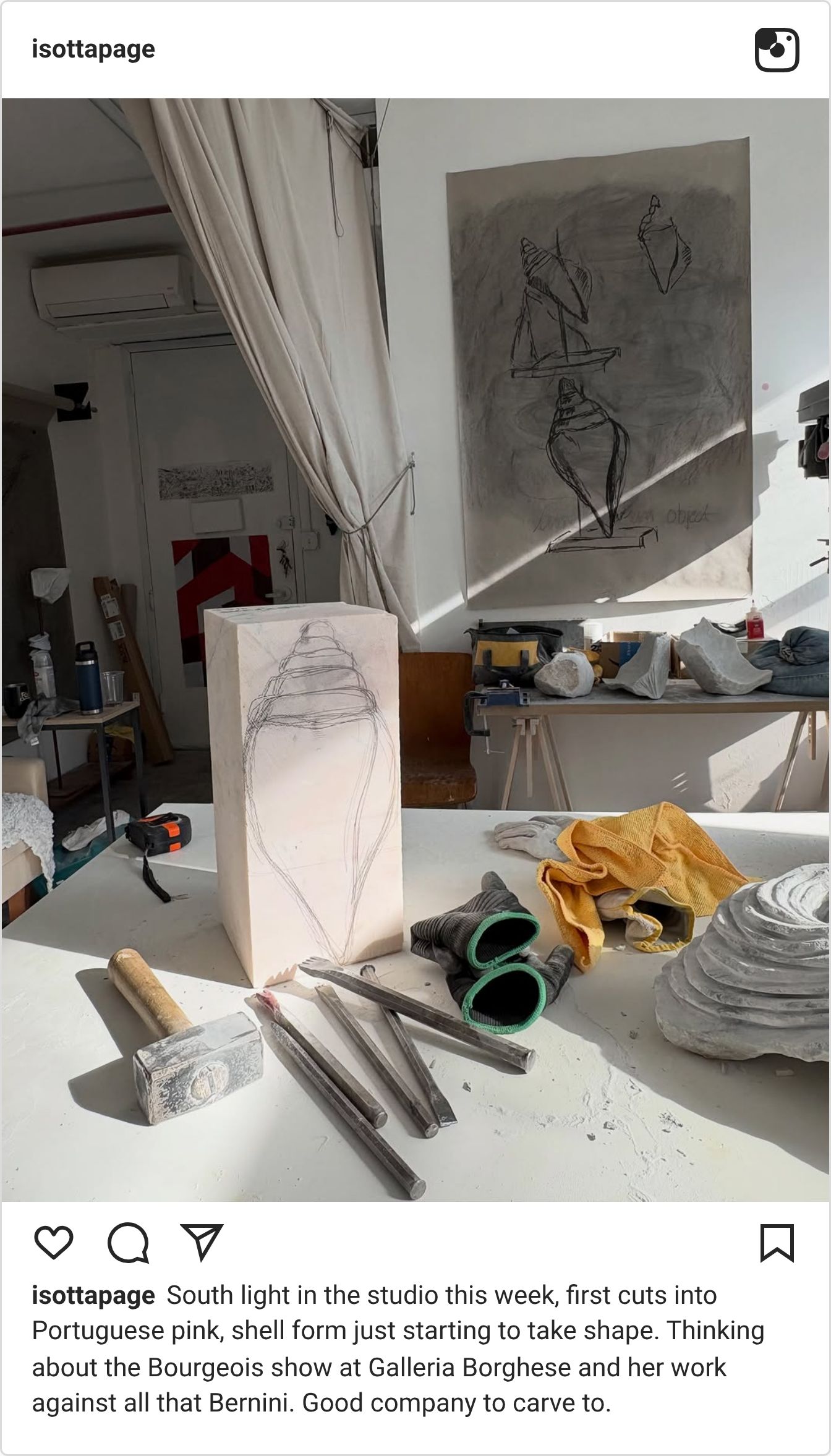
The shell is also a form I’ve carried since childhood in Rome, where it appears in fountains, niches and doorways all over the city. The Baroque shells of Bernini and Borromini have been a particular fixation of mine (I used to give tours of their churches when I worked as a guide in Rome), and I’ve returned to them again and again.

Shell & Sea, 2026, Carrara Marble & Steel, 113 × 30 × 19cm

Shell & Sea, 2026, Carrara Marble & Steel, 113 × 30 × 19cm
Shell & Sea brings these influences together: two carved shells on a single line of steel, one supporting the other as it rises. Like Superposition, which I wrote about in my last newsletter, it’s part of my effort to make marble light, a theme running through all five new sculptures. Here, a stone that settled at the bottom of an ocean is lifted into the air, held in a self-supporting system. The natural world works the same way, each part holding up another. When that balance breaks, as it is breaking now, the planet does recover, but over millions of years. This piece is a reminder of how long that kind of repair takes.
The work speaks to the origins of marble, the marine organisms that settled on the floor of the Tethys Ocean close to 200 million years ago and slowly became limestone, later recrystallised into marble. It also speaks to the art historical roots that have shaped my work from the start.

Shell & Sea, 2026, Carrara Marble & Steel, 113 × 30 × 19cm
As my marble carving teacher told me on the first day of class, all marble is ancient. In Shell & Sea, the stone is carved into the very thing it was made from, so the sculpture points back to its own beginning.
Shell & Sea is the second of the five sculptures I carved this summer, and it is available ahead of the holidays. A list of available work with prices is attached below. If one stays with you, reply to this email. I’m happy to share more images or arrange a studio visit.
Thanks for reading.
Warmly,
Isotta

Fotos by CARLSON ART PHOTOGRAPHY
1 These ideas come from geologist Marcia Bjornerud’s book Timefulness and physicist Sara Imari Walker’s work on assembly theory.
