Dear Friends,
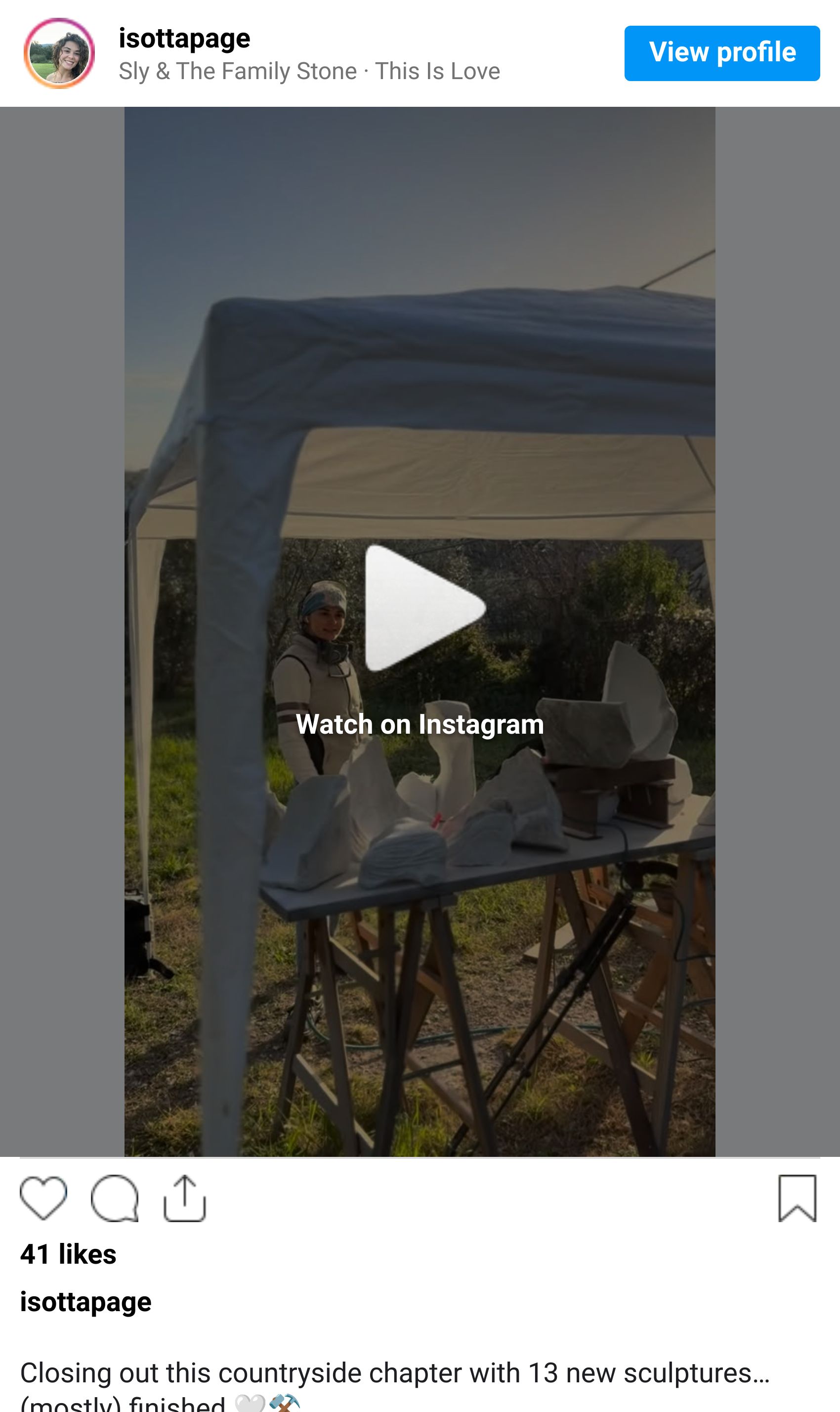
This month marks an exciting transition for me. For the past 18 months I have been based in Fara Sabina, a beautiful rural area just north of Rome. Living in the quiet of the countryside has allowed for a rare kind of concentration. Days have been structured almost entirely around the studio, and I’ve been able to dedicate myself fully to developing a new body of sculptural work.


Conch, Carrara marble, 2026
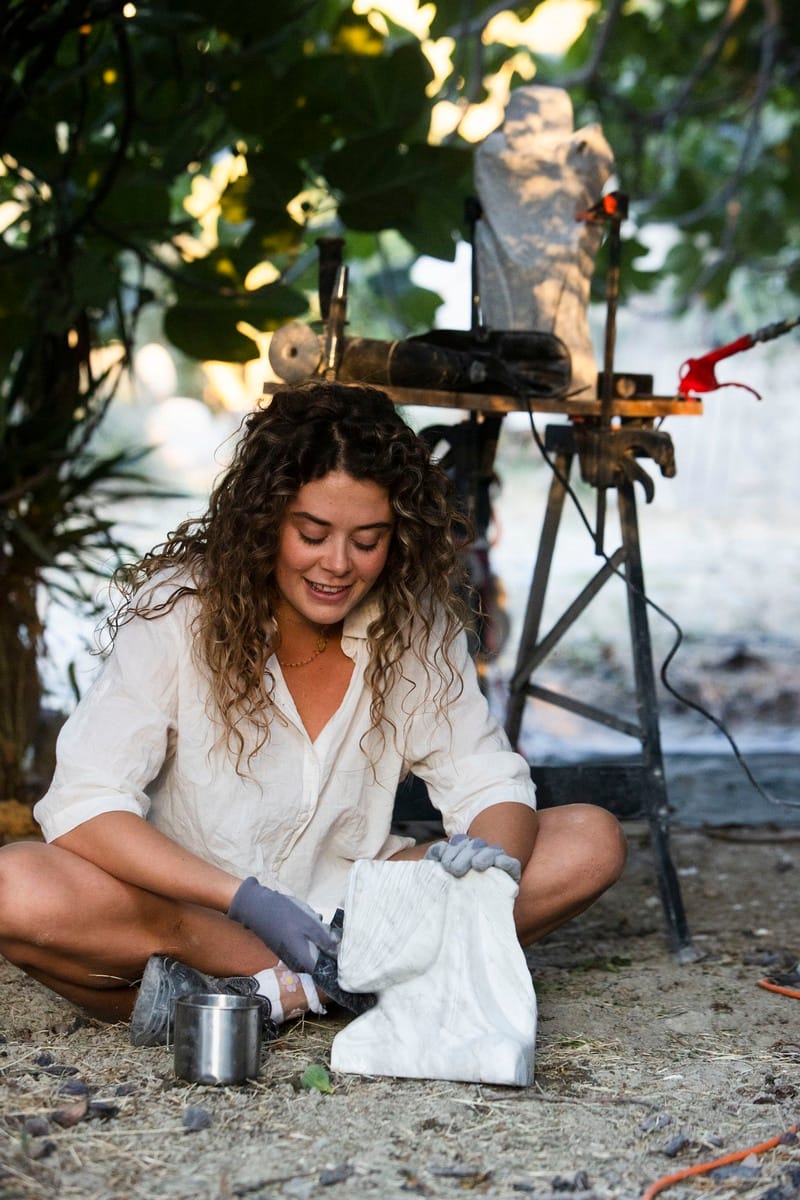
This sustained focus has been essential as marble carving requires a great deal of time and energy. Thankfully the rhythm of the countryside was conducive to productivity in the studio and my environment, the olive trees, green grass and (mostly) blue skies have deeply shaped this new series. However, our chapter of countryside bliss has come to a close and I’m excited to share that my husband and I will now be based in New York City!
The energy and pace of the city feels electric and I’m currently in New York signing a lease on a new studio space and sorting through the logistics of setting up life here. Being back in the city has also reminded me of my last visit in October, when I attended the American Academy Gala afterparty honoring sculptor Barbara Chase-Riboud and author Anthony Doerr. I have long admired Chase-Riboud’s work but was less familiar with Doerr. At the event, the Academy gifted us copies of both honorees books and I was delighted to discover that Doerr’s was a short nonfiction account of his time living in Rome in 2006.
The book titled Four Seasons in Rome is a charming read and stayed with me over the past few months, especially his reflections on marble and ancient Roman ruins. Drawing on Pliny’s Natural History, Doerr describes Roman monuments not simply as symbols of power but as feats of material, labor, and geologic endurance. In his passage about Trajan’s Column, he reminds the reader that the monument is made from eight hundred tons of Carrara marble quarried, transported, and carved nearly two thousand years ago.

Time Traveller, Carrara marble & steel, 2026

Trajan’s column in Roman Forum circa 113 AD
Over the past two years I’ve become increasingly interested in different chronologies of time, especially the idea of deep time, the immense geological timescales that shape our planet. Seen through that lens, Trajan’s Column and the ruins of Rome begin to feel less ancient. We marvel that these monuments have survived for two thousand years, yet from the marble’s perspective almost no time has passed. The stone formed millions of years ago and will endure for millions more, hopefully in their current state of preservation.
Moving from Rome to New York brings time into clearer focus. Rome is shaped by ruins two thousand years old, while New York’s monumental skyline is only decades in the making. Yet both feel negligible when viewed against the scale of deep time.
The other day while walking through Central Park, my friend reminded me that New York sits on its own deep geologic story. Throughout the park you see huge boulders nestled between trees and perfectly maintained pedestrian walkways. I learned that these rocks are examples of the ancient metamorphic bedrock which formed during the building of the Appalachian Mountains and were later whittled away by time and sculpted into their current forms by Ice Age glaciers that once covered Manhattan..!

Time Traveller, Carrara marble & steel, 2026
A resource I’ve been returning to in order to help contextualize these immense time scales is Timefulness, a book by geologist Marcia Bjornerud. In it, she describes a simple, though in her view somewhat reductive, way to picture geologic time. If the entire 4.54-billion-year history of the Earth were compressed into a single 24-hour day, the timeline would look like this:
12:00 a.m. Earth forms
3:00–4:00 a.m. First life appears
Around 9:00 p.m. Complex multicellular life emerges
Just before 11:00 p.m. Carrara marble forms deep underground
Just before 11:58 p.m. Dinosaurs appear
11:59:58 p.m. Homo sapiens appear
Final two seconds before midnight Ancient Rome and all of recorded human history up to the present moment
I like the idea of marble as a time traveller, or perhaps as a material that helps us time travel. Everything about it involves time: the millions of years it took to form, the thousands of years it has been extracted and used by humans across the world, and the hundreds of human hours it takes to carve and shape it into forms that endure time.
In response, my new series of sculptures explores how form can speak to the enormity of geologic time. I’m drawn to shapes and natural forms that bridge the micro and the macro. Shells, fossils, and bones speak to the memory of living things, while mountains embody the slow, monumental processes of the earth aging and evolving.
I’ve been carving marble fragments into forms that oscillate between these scales: a conch shell that feels like a mini landscape, or a mountain peak that you would only see from an airplane window.

Volute, Carrara marble, 2026

Vetta, Carrara marble, 2026
I’ve paired these marble sculptures with steel bases because I’m interested in how the permanence of stone meets the tension of rusty steel, an aged industrial material. Together they create a dialogue between natural history and human intervention through man made and manipulated materials.
A small selection of sculptures are available, and I would be happy to share more information with anyone interested in collecting the work. Please feel free to write to me directly for further details and pricing, your interest and support means so much to me thank you for reading. And if your in NYC reach out I would love to reconnect!
Warmly,
Isotta


Volute, Carrara marble, 2026